

Local climate adaptation will have significant economic impacts in the coming years. The scale and pace of adaptation will play a key role in determining how strongly physical climate risks affect regions, economic structures, and asset values in the future. For regional credit institutions, this raises the question of how these developments may translate into their own risk exposure over the medium to long term.
A look at the macroeconomic damage and the investment required in Germany shows that climate adaptation is already economically relevant today for limiting climate-related costs.
A study commissioned by the German federal government on climate-related costs in Germany concludes that economic losses caused by extreme weather events between 2000 and 2021 amounted to at least EUR 145 billion. Since 2018 alone, losses of around EUR 80 billion have occurred, with the 2021 flood disaster in the Ahr Valley accounting for more than EUR 40 billion. Looking ahead to the period up to 2050, the study estimates cumulative losses of between EUR 280 billion and EUR 900 billion, depending on the climate scenario.
These figures illustrate the expected scale of physical climate risks in Germany and provide the macroeconomic framework for regional climate adaptation.
To limit the extent of damage, substantial investments are required to make regions and municipalities more resilient to climate risks. According to the German Environmental Agency (Umweltbundesamt), federal spending on climate adaptation in the 2022 federal budget amounted to between EUR 2.07 billion and EUR 3.41 billion, depending on the classification used.
Indications of the scale of the required investment needs are provided by municipal demand estimates. KfW Research puts the overall municipal investment requirement for climate-related investments at around EUR 5.8 billion per year. In a statement by its Chief Executive Officer, the German Association of Towns and Municipalities (Deutscher Städte- und Gemeindebund) assumes investment needs of at least EUR 8 billion per year for climate mitigation and climate adaptation at the municipal level. These estimates refer to the required investment need and do not represent reported expenditures; rather, they constitute expert assessments of the order of magnitude that pose challenges for municipal planning and financing.
These figures provide an initial indication of the federal expenditures for climate adaptation that have been reported to date. Systematic data on the actual expenditures incurred by federal states (Länder) and municipalities are not yet available, nor are comprehensive data on private investments in climate adaptation, such as measures to protect production facilities or residential buildings against flooding and flash floods. Existing demand estimates also frequently relate to climate investments in general and do not consistently distinguish between climate mitigation and climate adaptation.
Taken together, the available data nonetheless suggest that there is a relevant gap between climate-related damages already incurred, identified investment needs, and the funds that have so far been visibly mobilised. As climate change progresses, this gap can be expected to widen further unless adaptation investments are significantly increased. For regions and municipalities, the question of how necessary adaptation measures can be implemented in a timely and financially viable manner is therefore becoming increasingly important.
Transmission of Physical Climate Risks into Banking Risks
From a regulatory and supervisory perspective, climate-related risks are considered drivers of existing risk categories. In its report on Climate-Related Risk Drivers and Their Transmission Channels, the Basel Committee on Banking Supervision describes how physical climate risks can translate into credit risks through their impact on borrower creditworthiness, assets, and collateral.
The European Central Bank follows the same logic. The ECB Economy-Wide Climate Stress Test models, among other things, how physical damage can affect loss parameters such as loss given default via property values and other asset positions.
This clearly defines the channels through which physical risks can feed into the risk exposure of regional credit institutions.
Collateral, Property Values, and Insurability
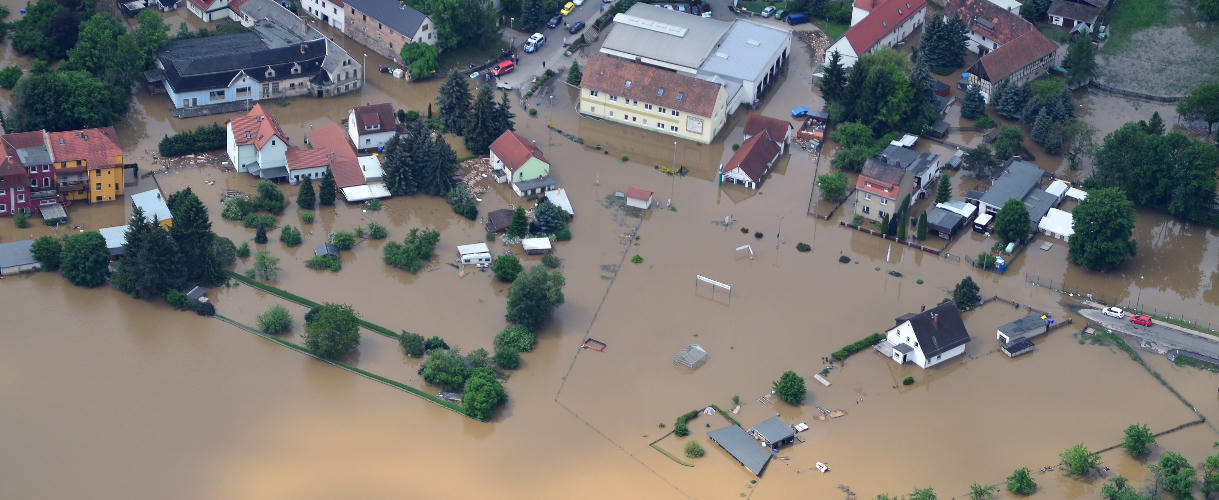
One important area in which physical climate risks take effect concerns real estate used as loan collateral. Empirical studies, such as the one by Gruhl et al. (2025), show that flood risks and other climate-related hazards in certain regions can be associated with price discounts or increased volatility. Market adjustments are not uniform, but vary across regions and over time.
Beyond market value alone, the insurability of properties is becoming increasingly important. In areas exposed to flooding or heavy rainfall, insurance premiums and deductibles rise, or certain risks may be excluded altogether. This expands the range of steering options available to credit institutions—from requiring natural hazard insurance, to risk-adjusted loan conditions, to exclusion criteria in particularly exposed zones.
These considerations show that physical climate risks already affect collateral quality and lending conditions today, beyond long-term valuation issues. As a result, insurability is increasingly becoming an indirect steering instrument in the credit process, particularly for new construction or major investments in risk-prone areas.
Creditworthiness of Regional Companies and Households
Physical climate risks also affect the earnings situation of regional companies. Extreme weather events can disrupt production processes, damage infrastructure, or cause additional costs, for example due to supply chain disruptions. Small and medium-sized enterprises in particular often have limited capacity to respond to such impacts in the short term.
An empirical study by Deutsche Bundesbank on the 2013 summer floods shows that natural disasters in affected regions can have measurable effects on bank indicators, including loan loss provisions.
These findings underline that physical climate risks can translate into traditional credit risks through borrower creditworthiness, often with a time lag.
Regional Risk Exposure and Concentration Effects

Regional credit institutions are geographically focused by the nature of their business model. Proximity to customers in the region is a strength, but when combined with spatially correlated climate risks it can lead to increased concentration effects. Extreme weather events often follow geographic patterns, such as river valleys, urban heat islands, or topographically exposed areas.
Aggregated damage data for Germany show that climate-related economic losses regularly reach several billion euros per year. For the portfolios of regional institutions, this increasingly means that physical risks may not only affect individual exposures, but potentially entire sub-portfolios. Depending on the climate scenario, these effects may vary in intensity over the coming years and decades.
Conclusion
The available data for Germany show that physical climate risks are already causing significant economic damage. The scenarios analyzed indicate that the scale of damage is likely to increase substantially in the coming decades. For regional credit institutions, growing impacts on collateral values, borrower creditworthiness, and overall regional risk exposure are to be expected.
Against this background, it appears necessary to significantly expand investments in climate adaptation in the coming years. Only in this way can climate-related damages be kept to a manageable level. In the area of municipal climate adaptation, a financing gap is emerging. Regional credit institutions can play an active role in closing this gap, for example by co-financing publicly funded adaptation measures.
Overall, physical climate risks and climate adaptation are thus becoming factors of growing importance for the risk controlling of regional institutions. Even if the transmission effects of physical climate risks currently appear relatively limited, it would be a fallacy to assume that this will remain the case over the medium to long term. In risk modelling, transmission effects can easily be underestimated if models consider individual risk drivers and their effects in isolation, rather than also examining cumulative risk scenarios.
Next Steps
Credit institutions take climate risks already generally into account as part of their risk inventory. Beyond this, it may be useful to systematically assess the effects of individual climate risk drivers: Which physical risks are particularly relevant at the regional level? Where are potential cumulative effects in the portfolio? Which portfolio segments are sensitive to recurring extreme events? And where might impacts on collateral or creditworthiness intensify over the medium to long term?
Another aspect concerns the role of regional credit institutions in financing climate adaptation. In addition to subsidised loans from the federal government and the Länder, for example via KfW, there may be an increasing need to provide complementary financing to enable local adaptation measures. These developments also feed back into regional risk exposure and warrant structured consideration.
If you would like to exchange views on these issues or share your perspective, I would be pleased to hear from you.