
Four years since the boom around generative AI began, more and more German companies are using artificial intelligence: Over half of companies currently use AI in their business processes, as the ifo Institute found out in May 2026. Within a year, AI usage rose from around 41% to nearly 55%. Over two-thirds of large companies (67%) already use AI, significantly more than small companies (51%) and medium-sized companies (47%). Overall, further strong growth in AI usage is expected, as 16% of surveyed companies plan to use AI, and around 22% are discussing it, according to the ifo Institute.
However, the rapidly growing use of AI obscures the fact that most companies have so far only tapped into the technology’s potential to a limited extent. Only about half of companies use generative AI on a larger scale, according to the KPMG study “Generative AI in the German Economy” (May 2025). Even if this proportion has grown since then, I suspect that many companies, especially in the mid-market, still use AI primarily in a piecemeal or exploratory way. Additionally, according to the KPMG study, 67% of surveyed companies had no clear ethical guidelines or governance structures for AI use one year ago. Yet these are precisely the prerequisites for the broad, responsible use of AI in core processes.
The impression of a strongly underdeveloped AI governance is confirmed by a current study from ZEW. According to this, only just under a third (30%) of surveyed companies in the manufacturing sector provide generative AI applications to their employees, usually through licenses and pro accounts for commercial providers. Nearly two-thirds (62%) allow the use of AI implicitly or explicitly without providing the tools themselves.
Based on the studies and my personal conversations with entrepreneurs, my impression is that many companies are still in the experimental phase and have not yet recognized AI as a strategic lever. Companies that remain in this development phase for too long risk falling behind competitors who act with strategic consistency in their AI usage.
Development Stages of AI Usage in Companies
AI usage in companies can be divided into four development stages, based on the combination of two determining factors: AI usage intensity and scope (x-axis in the diagram) and the development level of strategy and governance (y-axis). In my view, most companies are currently in the lower-left quadrant, the experimental phase. However, only companies that manage to move into one of the other quadrants can sustainably leverage AI’s value creation potential.
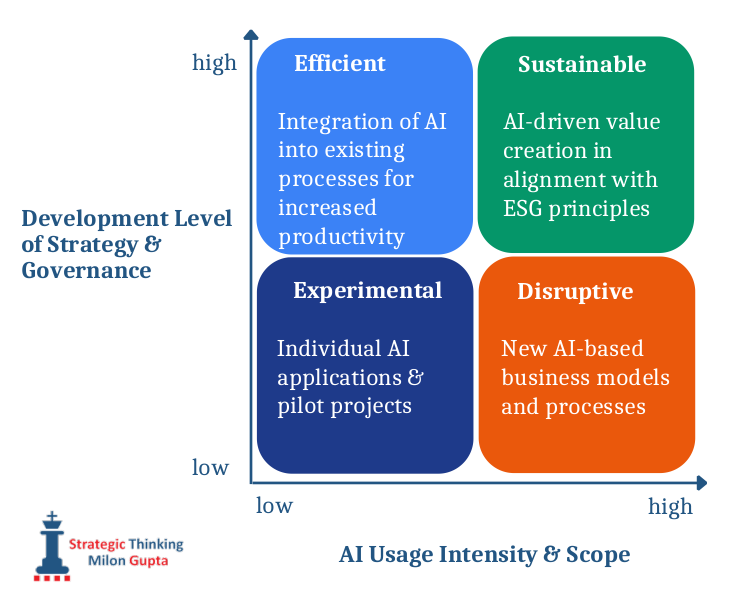
The four development stages presented are a strong simplification of a complex reality. However, they can help classify your company’s position and define strategic development goals.
The four development stages in detail:
Experimental
At this stage, companies primarily use AI in individual solutions or pilot projects without a clear strategy or governance. Often, generative AI applications are provided to employees or their use is tolerated. According to the ZEW Industry Report on the Information Economy from May 2026, 30% of companies in the manufacturing sector provide their employees with generative AI applications, 23% do not provide any applications but explicitly allow their use, and 39% tolerate the use of AI, for example via private accounts. This can quickly lead to shadow IT and data protection risks if no clear guidelines exist. The opportunity: rapid learning and initial experience with the technology. However, without strategic integration and clear governance, the benefits remain limited.
Efficient
Here, AI is deliberately integrated into existing processes to increase productivity. Typical applications include support for office tasks or supply chain optimization. According to a PwC study from November 2025, generative AI led to improvements for a clear majority of users: 65% of surveyed employees said that generative AI had improved their work quality, and 62% reported increased productivity. However, only 9% of employees use generative AI daily. Many companies can therefore still tap into significant efficiency potential. Even if this happens, another challenge remains: without a long-term vision and corresponding strategy, AI can bring efficiency but rarely creates sustainable competitive advantages.
Disruptive
At this stage, companies develop new AI-based business models and processes that sometimes have market-changing potential. Pioneers here are primarily startups and high-tech companies that use AI for innovative solutions, such as in logistics or customer service. The opportunity: opening up new markets and positioning oneself as a pioneer. The risk: high investment requirements and scaling pressure to occupy new markets.
Sustainable
At this stage, AI is firmly embedded in the company strategy and, in line with ESG principles, contributes to long-term value creation. So far, I am not aware of any companies that have reached this stage.
The challenges are immense: making AI ESG-compliant requires mature governance structures, clear ethical guidelines, and a culture that, on the one hand—like in the disruptive development stage—promotes AI-driven change, while on the other hand consistently minimizes negative ecological and social impacts to ensure responsible AI use.
At the end of the day, the positive ecological and social impacts of AI should outweigh the negative ones in this stage. Achieving this while simultaneously optimizing AI investments and productivity is a tremendous task. The opportunity: companies that strive for and achieve this stage can gain sustainable competitive advantages that surpass those of companies in the disruptive stage, as ecological and social factors are fully taken into account.
Why Many Companies Are Still Stuck in the Experimental Stage
Based on the studies and my personal conversations with entrepreneurs, my impression is that many, if not most, companies are still in the experimental stage of AI usage. To remain competitive, companies should aim to reach at least the efficient usage stage in the short term.
The biggest mistake companies often make is using AI without a clear strategy and consistent governance. Without clear governance and a long-term vision, AI remains a tool without leverage. According to a 2025 KPMG study, 69% of surveyed companies had no AI strategy. Companies without an AI strategy risk not fully utilizing AI’s economic potential and underestimating the risks of unmanaged AI use.
The leap from the experimental phase to efficient usage is achievable for any company if three factors are in place: 1. a clear strategy that treats AI as a core competency, 2. governance that minimizes risks, and 3. change management that brings employees along.
Many companies will short- to medium-term refrain from pursuing the disruptive or sustainable stages of AI usage and instead focus on reaching the efficient stage. What matters is that this is a strategic decision for the company, which must then be consistently implemented.
How Companies Can Reach the Next Development Stage
The path from the experimental phase to sustainable value creation requires a structured approach. Start with an inventory: Where does your company currently stand regarding AI usage? Are you already using AI in individual projects, or is it integrated into your core processes? Define clear goals: Should AI primarily increase productivity or open up new markets for you? Are there rules for AI use? Without clear governance structures and rules, the risks of AI remain difficult to control.
Conclusion and Next Steps
Using AI is economically necessary to remain competitive in the long term. However, only those who deploy AI strategically can benefit from it in the long run. Companies that stay in the experimental phase for too long risk being overtaken by more innovative competitors. That’s why swift and thoughtful action is now required.
If you need a structured impulse for the necessary inventory, you should book my AI Strategy Check, which will give you cost-effective and quick clarity on the current state and development opportunities of AI usage in your company. Schedule a free appointment with me to learn more about the AI Strategy Check.